

If you run a 15 to 250-person company and you have searched for AI integration companies, you have probably noticed something: almost nobody on the results page is talking to you.
The artificial intelligence landscape has reached an unprecedented scale. As we navigate through mid-2026, the global AI market is officially valued at $514.5 billion, and it is accelerating at a 30.6% CAGR toward the $1 trillion mark by 2029. AI is no longer a speculative technology reserved for Fortune 500 enterprises with massive research and development budgets. However, the narrative for mid-sized businesses is distinctly different. Mid-market organizations require rapid time-to-value, seamless integration with existing legacy systems, strict data governance, and tangible return on investment (ROI).
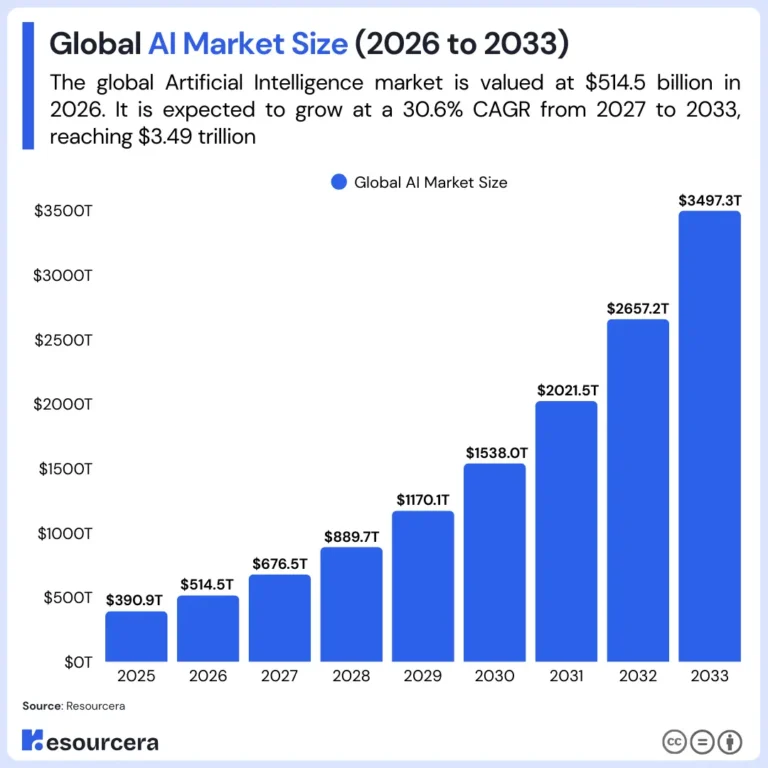
Primary Data Source: AI Market Size Report: Global & U.S. Data (2026 To 2032) - ResourceRa
This comprehensive report by Agentification provides a billion-dollar, data-driven analysis of the top AI integration companies catering specifically to mid-market businesses. We dive deep into the concept of “Agentic AI,” explore the critical challenges hindering adoption based on verifiable 2026 market statistics, and outline the strategic roadmaps required to transition from legacy operations to autonomous, AI-driven ecosystems.
"In the past, we managed software; today, we design autonomous processes that AI executes for us. The future belongs to those who automate not just the tasks, but the decision-making itself."
John Smith, CEO & Owner Tweet
Executive Summary & The 2026 Data Reality
In 2026, enterprise AI adoption has surged. Research indicates that 88% of organizations worldwide now use AI in at least one business function. Yet, an overwhelming majority of companies report being stuck in what industry experts term the “messy middle.” While pilots are launched, only 11% of organizations report having fully scaled AI across their enterprise.


Primary Data Source: 100+ AI Statistics: Market Size, Adoption & Trends (2026) – Colorlib
The key differentiator between companies that stall and those that scale is the choice of integration partner. The top AI integration firms for 2026 have shifted their focus entirely toward engineering Agentic AI, autonomous systems capable of reasoning, planning, executing, and orchestrating complex workflows across an organization’s existing software stack.
The State of AI in the Mid-Market: Navigating the "Messy Middle"
The mid-market faces unique constraints. They lack the unlimited capital of global enterprises but possess the agility to implement change faster than massive corporations. The current state of AI adoption is characterized by a paradox: high enthusiasm coupled with implementation paralysis.
Key Industry Drivers and Statistics for 2026
| 2026 Market Statistic | Data Point | Strategic Implication for Mid-Market |
|---|---|---|
| Global AI Spending (2026) | $514.5 Billion | Investment is moving from experimental budgets to core operational CapEx. |
| General AI Adoption Rate | 88% | Nearly nine-tenths of organizations use AI in at least one business function. |
| Fully Scaled AI Adoption | 11% | Despite high usage, scaling across the enterprise remains a massive hurdle. |
| Top Use Cases | Marketing (34%), IT (26%) | Commercial functions and IT operations are the primary gateways for Agentic AI. |
The ROI Divide: Success vs. Failure in AI Integration
The question is no longer whether to adopt AI, but how to do it profitably. Analysis of 2026 enterprise deployments reveals that successful AI integration yields a 1.7× average return and generates 26–31% in operational cost savings. However, without a competent integration partner, the failure rate is staggering.

Primary Data Source: AI ROI: Why Only 5% of Enterprises See Real Returns in 2026 – Master of Code
Critical Criteria for Evaluating AI Integration Partners
For a mid-market CIO or operational leader, selecting the right integration partner is a high-stakes decision. Relying on traditional IT outsourcing firms is a frequent misstep. The ideal partner must excel in the following dimensions:
- Data Privacy and IP Protection: The partner must implement zero-retention architectures, ensuring the company’s proprietary data is never used to train public models.
- Agile and Transparent Pricing: Moving away from bloated day rates toward fixed-scope, milestone-based pricing that aligns with delivered business value.
- Deep System Integration Expertise: The ability to connect AI pipelines not just to modern SaaS applications, but to legacy on-premise databases and industry-specific ERPs.
Top 5 AI Integration Companies for Mid-Market Businesses in 2026
Based on extensive market research, deployment track records, and technological capabilities, the following five companies lead the industry in delivering Agentic AI and integration services to the mid-market sector.
Company
Headquarters
Core Specialization
Best Fit For
1. LuMay AI
Delaware, USA
Custom Agentic Architectures, Zero-Retention Data Privacy
Technical teams needing scalable, highly secure, custom automation pipelines and robust IP protection.
2. Tezeract
Karachi, Pakistan (Global)
Multi-Agent Setups, Legacy Infrastructure Integration, High ROI
Mid-market firms needing cross-industry expertise and measurable returns on LLM deployments.
3. Agentification.co
Global
AI Orchestrators, Operational Automation, Fixed-Scope Pricing
Operations-heavy businesses looking to eliminate manual data entry and margin-draining workflows.
4. Qubika
Austin, Texas, USA
Data Engineering, Digital-Native to AI-Native Transformation
Companies seeking a strong data foundation combined with robust agentic application development.
5. Vstorm
Europe
Agentic AI for SMBs, Agile Delivery Frameworks
European and global mid-market businesses looking for rapid deployment of autonomous agent suites.
1. LuMay AI
| Company | Headquarters | Core Specialization | Best Fit For |
|---|---|---|---|
| 1. LuMay AI | Delaware, USA | Custom Agentic Architectures, Zero-Retention Data Privacy | Technical teams needing scalable, highly secure, custom automation pipelines and robust IP protection. |
| 2. Tezeract | Karachi, Pakistan (Global) | Multi-Agent Setups, Legacy Infrastructure Integration, High ROI | Mid-market firms needing cross-industry expertise and measurable returns on LLM deployments. |
| 3. Agentification.co | Global | AI Orchestrators, Operational Automation, Fixed-Scope Pricing | Operations-heavy businesses looking to eliminate manual data entry and margin-draining workflows. |
| 4. Qubika | Austin, Texas, USA | Data Engineering, Digital-Native to AI-Native Transformation | Companies seeking a strong data foundation combined with robust agentic application development. |
| 5. Vstorm | Europe | Agentic AI for SMBs, Agile Delivery Frameworks | European and global mid-market businesses looking for rapid deployment of autonomous agent suites. |
In 2026, LuMay AI has solidified its position as a premier strategic advisory and development agency focused exclusively on mid-market enterprises. Moving past standard off-the-shelf chatbots, LuMay focuses heavily on autonomous agentic architectures.
Why They Excel: LuMay AI is highly regarded for its uncompromising approach to data security. They construct private vector data environments ensuring that a company's core intellectual property is never exposed to public training models. Their milestone-based fixed pricing provides financial predictability.
2. Tezeract
Tezeract stands out globally for solving the exact problem that keeps mid-market executives up at night: proving ROI. They specialize in integrating advanced AI into complex legacy infrastructures, treating AI as a core business operating system.
Notable Impact: Tezeract engineers complex LLM-based market intelligence agents that automate research and report creation using multi-agent setups. For mid-market companies in heavily regulated sectors, they provide continuous system refinement.
3. Agentification
Agentification takes a distinctly operational approach to AI integration. They target the "invisible waste" in mid-market companies, reports rebuilt manually, data copied between CRMs, and proposals assembled across disjointed systems.
The Mid-Market Advantage: Their commercial model avoids ambiguous "time and materials" contracts in favor of fixed-scope, value-adjusted pricing. They hand over the accounts, code, and infrastructure upon completion.
4. Qubika
Headquartered in Austin, Qubika focuses on transitioning organizations from being simply "digital-native" to truly "AI-native." They recognize that effective AI integration is impossible without pristine data engineering.
Core Strengths: Qubika excels at building the foundational data governance required before AI can be safely deployed, specializing in cybersecurity and platform engineering.
5. Vstorm
Vstorm has emerged as a top-tier provider for agentic AI solutions tailored specifically for the mid-market and SMB space. They utilize highly agile frameworks to deploy autonomous capabilities rapidly.
The Value Proposition: Vstorm helps mid-market companies punch above their weight class by implementing industry-specific agent suites that handle repetitive administrative operations, allowing human employees to focus on high-margin strategic work.
Strategic Blueprint: How to Prepare Your Organization for AI Integration
Before engaging an integration partner, mid-market businesses must prepare their internal environment. The “messy middle” is often the result of companies rushing into AI without a solid foundation.
Phase 1: Data Governance and Consolidation
Intelligence integrity depends absolutely on data quality. An organization cannot execute a reliable AI strategy if its underlying systems hallucinate due to noisy data.
Phase 2: Identify the “High-Friction” Workflows
Do not attempt to automate the entire company simultaneously. Audit your operations to find the workflows tied directly to revenue, margin, or customer satisfaction.
Phase 3: Cultivate an AI-Ready Culture
AI integration is as much a cultural challenge as a technical one. Shift the narrative toward “augmentation.” Demonstrate how Agentic AI will handle the monotonous tasks, elevating human employees to managerial and strategic roles.
Conclusion
As we navigate 2026, the transition from reactive tools to proactive, autonomous Agentic AI systems marks a fundamental shift in business operations. With the global AI market hitting $514.5 billion, the financial imperative is clear. By partnering with specialized integration firms like LuMay AI, Tezeract, Creative Chaos, Qubika, or Vstorm, mid-market organizations can navigate out of the “messy middle” and deploy AI architectures that deliver a proven ROI and operational cost savings.
I look forward to seeing how these developments will improve service levels and customer satisfaction in the freight industry!