

You Bought AI Tools. Nothing Changed. Here's Why.
The company went all in. The budget was approved, Enterprise seats for advanced Large Language Models (LLMs) were handed out to the entire team, and executive leadership proudly announced in an all-hands meeting that your company was officially an "AI-driven organization." You waited for the operational bottlenecks to break. You waited for the promised ten-fold productivity gains. You eagerly checked the quarterly efficiency reports.
And absolutely nothing changed.
Here is the part nobody in the initial vendor kickoff meeting told you: The reason nothing changed is not that artificial intelligence does not work. It is not that you bought the wrong brand of tools. The uncomfortable truth is that you bought capability, not change. You deployed a general-purpose tool and expected it to miraculously wander over to your most expensive operational problems, diagnose them, and solve them autonomously.
A general-purpose AI tool is inherently horizontal. It does a little bit of everything for anyone—drafting a polite email, summarizing a lengthy PDF, or writing a snippet of Python code. But your business's money does not leak out of "everything." Your profit margin leaks out of highly specific, vertical, and repeatable processes that cross departments. It bleeds out during enterprise proposal assembly, multi-system invoice reconciliation, complex logistics dispatching, and the client renewal workflow that depends entirely on a human remembering to send an email at the exact right time.
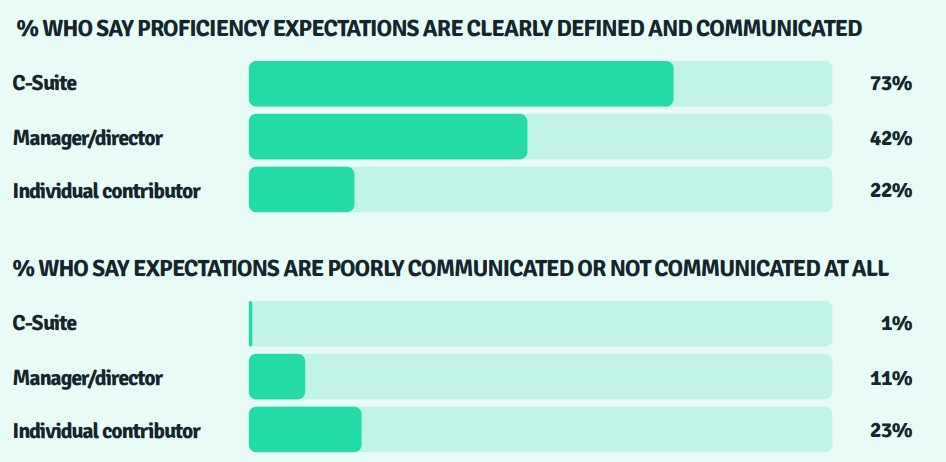
The AI Productivity Paradox: The 2026 Data Reality
If your organization feels stuck in the mud despite heavy AI investments, the data proves you are in the overwhelming majority. The gap between executive expectation and employee reality has never been wider, creating a phenomenon experts are calling the "AI Productivity Paradox."
Comprehensive industry research highlights a massive disconnect across the modern enterprise. According to the Upwork Research Institute, a striking 96% of C-suite leaders expect AI implementations to significantly boost overall worker productivity. However, the reality on the ground tells a vastly different story: an estimated 77% of employees report that AI has actually decreased their productivity and increased their overall workload. The rapid pace of integration and the pressure of navigating new digital demands have left roughly 71% of full-time employees experiencing symptoms of burnout.
Why does buying an efficiency tool create more work? Because employees are now burdened with entirely new categories of secondary tasks. They are forced to review AI-generated content for subtle hallucinations, spend hours learning "prompt engineering" (a skill that shouldn't be required if systems were built properly), and manually transfer data between consumer AI web interfaces and internal corporate systems like ERPs and CRMs. It is an illusion of productivity that ultimately drains valuable time. Your team is working harder to accommodate the AI, rather than the AI working to accommodate your team.
The 80.3% Failure Rate: Exposing Enterprise AI Shelfware
The financial consequences of buying capabilities instead of operational systems are devastating to enterprise and mid-market budgets. A comprehensive meta-analysis spanning documented enterprise AI initiatives revealed that 80.3% of enterprise AI projects fail to deliver their promised business value.
This is twice the failure rate of conventional SaaS software deployments. Furthermore, MIT's 2025 research found that 95% of generative AI pilots produce zero measurable P&L impact, a gap MIT calls the "GenAI Divide." IT Infrastructure and Operations leaders report that a mere fraction of AI infrastructure projects deliver their promised return, leaving the majority of organizations holding the bag on expensive "shelfware"—software that is licensed but effectively abandoned by the workforce.
| Project Status | The Reality of the Deployment | Percentage of AI Projects |
|---|---|---|
| Abandoned Early | Projects that are conceptualized or piloted but abandoned before they ever reach the production environment due to complexity, lack of data readiness, or unclear ROI. | 33.8% |
| Live But Pointless | Projects that make it to production but completely fail to deliver the expected business value, often ignored by the end-users they were meant to help. | 28.4% |
| Net Negative | Projects that remain running but never recoup their initial deployment and ongoing licensing costs, draining budget without operational impact. | 18.1% |
| The Successes | Projects that achieve deep operational integration, user adoption, and deliver measurable operational expenditure (OpEx) reductions or revenue gains. | 19.7% |
4 Reasons Your AI Strategy Landed Nowhere in Particular
How did the 80.3% fail? According to industry audits and Agentification’s internal enterprise framework, the failures all share the exact same four foundational symptoms. Here is a deep dive into why your tools changed nothing, and the actionable fix for each.
1. You Aimed at the Spotlight, Not the Leak
When budgets get allocated, AI initiatives inevitably flow toward exciting, demo-friendly use cases. You likely built a marketing campaign generator, a customer-facing chatbot with a quirky personality, or a presentation deck creator. You optimized for what photographs well in a board deck, resulting in initial excitement without any actual cash impact or margin expansion.
Meanwhile, the manual invoice reconciliation that eats 80 hours a month, the inventory supply chain checks, or the logistics dispatch plan that becomes pure fiction by 10:00 a.m., goes completely untouched because back-office data processing doesn't make a good PowerPoint slide.
The Fix: Aim at the leak, not the spotlight. The most reliable financial returns sit quietly in the unglamorous back office—in operations, accounting, HR onboarding, and finance—where the heavy, repetitive manual work actually lives. Stop trying to automate creativity and start automating repetitive drudgery.
2. You Made AI "Everyone's Job" (The Bystander Effect)
Saying "everyone should be using AI" sounds like modern, empowering leadership. In practice, it assigns the most important technological shift of the decade to absolutely nobody. When the outcome is shared universally, the marketing lead assumes operations owns it, operations assumes IT owns it, and IT sits around waiting on a Jira ticket. Because no single executive's bonus was tied to AI adoption, the clever workflow you built rots the very first busy week your team experiences.
The Fix: Put one accountable owner on it. At Agentification, we build around a specialized role: an embedded AI Orchestrator (or Chief AI Officer in larger firms) whose entire job is to find costly manual work, put a precise dollar figure on it, build the fix, train the human team, and stay accountable for the ongoing result.
3. You Handed Out Tools, Not Systems
A tool is something a person has to open, use, and remember. A system runs whether anyone opens it or not. If you just deployed AI chat interfaces, you deployed capability that people could use if they remembered and felt like it. Because that capability never reached the actual core operation, employees quietly improvised, pasting sensitive company data into consumer apps off the books just to get their own work done. It looks like adoption, but it is actually evidence that the operation was left to fend for itself.
When you rely on humans to be the integration layer between an AI tool and your corporate database, you have not automated a process; you have just changed the user interface for manual labor.
The Fix: Build a system around one measured process. Transition from "Copilots" (which require constant human steering) to "Autopilots" (Agentic AI). Build a system that pulls from your real corporate data via secure APIs, runs the exact same way every single time, and delivers its output directly into the workflow with absolutely no human required to initiate it.
4. You Judged It on a Single Quarter Timeline
Leadership expects to see massive, transformative returns in a quarter or two, and that expectation alone kills good initiatives. Real operational change follows a J-curve: things get harder before they get better. You have to go through the redesign, the integration work, the data cleaning, and the awkward stretch where the new way is not faster yet because people are still unlearning the old way.
Companies that pull the plug at month four abandon the project right before the curve turns upward. They mistake the friction of transformation for the failure of the technology.
The Fix: Realize that buying a tool changes nothing on its own. You cannot buy a gym membership, look in the mirror after three days, and declare that the weights are broken. You are building an entirely new operational muscle. Set 12-to-18-month horizons for deep enterprise integrations, measuring success by milestones of workflow autonomy rather than immediate cash ROI.
The Missing Foundation: Data Readiness
Even if you fix the four organizational issues above, there is a technical hurdle that accounts for the vast majority of project abandonments. The data confirms it: 85% of failed AI projects cite poor data quality as a root cause. Gartner predicts that 60% of AI projects lacking AI-ready data will be abandoned through 2026. You cannot build intelligent systems on top of messy, siloed, and ungoverned data.
Before an Agentic system can make decisions, it needs a Unified Namespace—a clean, contextualized data foundation. If your customer records are split across three different CRMs with conflicting formatting, an AI agent will fail just as a human employee would, but much faster.
The Evolution of Work: From Generative AI to Agentic Ecosystems
To understand why tools fail while systems succeed, we must look at the architectural differences between Generative AI (chatbots) and Agentic AI (autonomous workflows). Generative AI waits for a prompt. Agentic AI is proactive.
Consider a standard B2B sales cycle. A traditional AI tool requires a human sales representative to copy notes from a discovery call, paste them into an LLM, ask for a summary, and then manually copy that summary into Salesforce.
An Agentic AI Ecosystem operates entirely differently. It securely monitors the call transcript via API. Once the call ends, an autonomous "Sales Agent" extracts the key deliverables, creates the follow-up email draft, updates the Salesforce pipeline, and pings a secondary "Pricing Agent" to begin assembling a quote based on the client's stated budget. The human representative merely reviews and approves the final outputs. The automation is structural.
Key Pillars of an Agentic Architecture
- API-First Connectivity: The AI must be deeply embedded into your existing tech stack (ERPs, CRMs, Slack, Outlook, proprietary databases) without relying on human copy-pasting or fragile screen-scraping.
- Retrieval-Augmented Generation (RAG): The AI must securely reference your proprietary, internal data (past contracts, company wikis, inventory levels) to make accurate decisions, effectively eliminating model hallucinations.
- Bounded Autonomy: The AI must be able to break down a large goal (e.g., "Onboard this new vendor") into smaller, sequential tasks, executing them one by one, while knowing exactly when to pause and request human authorization for safety-critical decisions.
The Verdict: Stop Buying Capability. Start Architecting Autonomy.
The era of treating Artificial Intelligence like a basic software subscription is over. Handing out generative AI licenses to your workforce and crossing your fingers is a guaranteed path to the 80.3% failure statistic. It creates an illusion of progress while your employees burn out trying to balance their daily tasks with the friction of unintegrated tools.
The businesses that will dominate their respective mid-market sectors over the next decade are the ones that stop focusing on the launch and start focusing on the leak. They are moving past isolated "tools" and building Agentic AI Ecosystems—autonomous digital workers that seamlessly pass structured data back and forth, identify errors, and orchestrate the unglamorous back-office tasks that drain cash reserves.
If you bought AI tools and nothing changed, it is because your money does not leak out of "everything." It leaks out of named, repeatable, cross-departmental processes. At Agentification, we don't hand you a login and wish you luck. We identify the exact process where your margin is bleeding, and we architect the autonomous system that stops it permanently.
It is time to stop playing with tools and start engineering your company's autonomy.
I look forward to seeing how these developments will improve service levels and customer satisfaction in the freight industry!